Yoga vs Pilates: What's the Difference?
Yoga vs. Pilates: What's the Difference and Which Is Right for You?
Yoga and pilates are both movement practices that build strength, flexibility, and body awareness — but they differ in origin, philosophy, and focus. Yoga is an ancient Indian tradition that integrates breath, movement, and mindfulness; pilates is a twentieth-century method developed for precise core conditioning and postural alignment. Both are offered at Aura. Wellness in New Orleans, where classes are led by certified instructor Kerstin Brown at The Shop, Metairie.
Where Did Each Practice Come From?
The Origins of Yoga
Yoga has roots going back over 5,000 years, originating in the Indus Valley and developed through Indian philosophical and spiritual traditions. The word yoga means union — referring to the joining of body, mind, and spirit. While the yoga most widely practiced in the West today focuses primarily on physical posture (asana), traditional yoga is an eight-limbed path that encompasses breath, concentration, meditation, and ethical principles.
The physical practice arrived in the West in the late 19th and early 20th centuries and has since diversified into many styles — from the slow, floor-based restoration of yin yoga to the dynamic, flowing sequences of vinyasa and the physically demanding heat of hot yoga.
The Origins of Pilates
Pilates was developed in the early 20th century by Joseph Pilates, a German-born trainer who created the method during World War I to rehabilitate injured patients. Originally called Contrology, it was designed to build precise muscular strength, improve postural alignment, and support injury recovery through controlled, breath-coordinated movement.
Joseph Pilates moved to New York in the 1920s, where his method was adopted by the dance community and gradually expanded into the mainstream fitness world. Today it is taught both on the mat (mat pilates) and using specialized equipment, most notably the reformer.
How Are Yoga and Pilates Similar?
Despite their different origins, yoga and pilates share a significant amount of common ground:
Both emphasize the connection between breath and movement
Both develop core strength, flexibility, and postural awareness
Both can be adapted for all levels — from beginners to advanced practitioners
Both cultivate a quality of presence and body awareness that distinguishes them from conventional gym training
Both have demonstrated benefits for stress reduction and mental clarity
Both are practiced without heavy equipment (at least in their mat-based forms)
This overlap is why many instructors — and many students — work with both. They are genuinely complementary practices.
What Are the Key Differences?
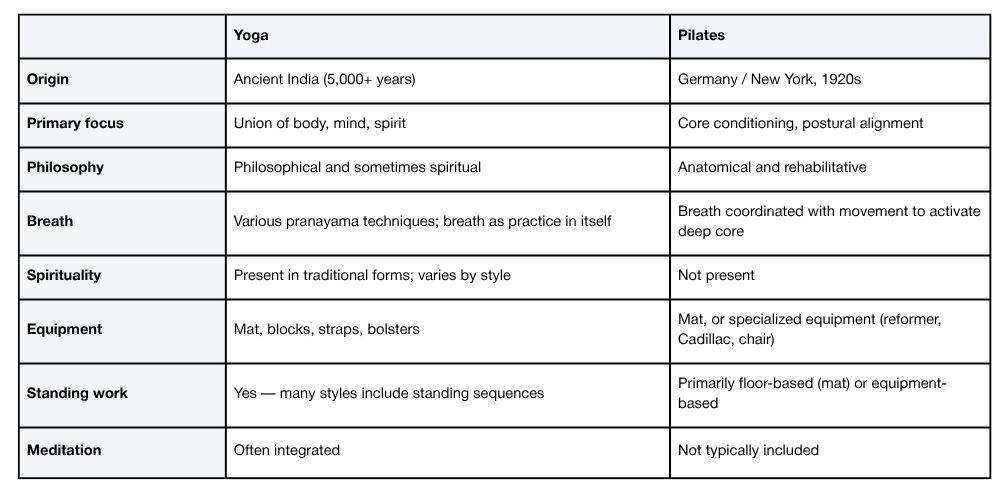
The Physical Benefits Compared
Both practices build real, functional strength — but with different emphases.
Yoga excels at:
Developing overall flexibility and range of motion
Building upper body and bodyweight strength
Improving balance and proprioception
Releasing chronic muscular tension, particularly in the hips, hamstrings, and shoulders
Supporting recovery from intense training through restorative practices
Pilates excels at:
Deep core conditioning — targeting the transverse abdominis, pelvic floor, and stabilizing muscles
Postural correction and spinal alignment
Rehabilitation of back pain, joint issues, and postural imbalances
Precise muscular control and coordination
Building strength without adding bulk
At Aura., Sculpt Flow (/aura-sculpt-flow) and Pilates (/aura-pilates) classes are designed to develop genuine functional strength, while Yoga (/aura-class-yoga) sessions honor both the physical and the spacious, mindful quality of the practice.
The Mental and Emotional Benefits
Both practices have well-documented effects on mental and emotional wellbeing — though they tend to reach that territory differently.
Yoga's integration of breathwork, meditation, and philosophy gives it a particularly direct pathway to stress reduction, emotional regulation, and a sense of inner quiet. Styles like yin yoga or restorative yoga work closely with the nervous system in ways similar to somatic healing (/aura-somatic), making them powerful tools for anxiety, burnout, and emotional processing.
Pilates supports mental wellbeing primarily through the meditative quality of focused, precise movement. The level of concentration required — particularly on equipment — naturally quiets the mind and builds a sense of embodied confidence and control.
Both are valuable. The question is simply which doorway suits you best right now.
Yoga or Pilates for Beginners?
Both are genuinely beginner-friendly when taught well — and at Aura., they always are. A few considerations:
Start with yoga if: you are drawn to a practice that integrates breath, mindfulness, and movement; if you are working through stress or emotional weight; if you want spaciousness and variety in your movement; or if the philosophical dimension of practice resonates with you.
Start with pilates if: you have back pain, postural issues, or a previous injury and want a precision-led approach; if you are recovering from other training and want to rebuild from a strong, stable foundation; or if you prefer a structured, anatomically focused method.
Try both if: you're curious, open, and want to develop a full-spectrum movement practice. Many of Aura.'s clients move between yoga, pilates, and other modalities depending on what their body needs from week to week.
Can You Do Both?
Not only can you — many practitioners find that combining yoga and pilates creates a more complete practice than either alone. Pilates builds the deep core stability and alignment that makes yoga postures safer and more effective. Yoga builds the flexibility, breath awareness, and spacious quality that enriches pilates work.
At Aura., the Sculpt Flow (/aura-sculpt-flow) class is a direct expression of this integration — drawing from pilates-informed strength work and yoga-led movement into a single class. Kerstin's own practice and teaching has always sat at this intersection, and it shows in how the sessions feel.
You might also explore Strength Training (/aura-strength) or Private Sessions (/aura-private) if you want a personalized program that draws deliberately from both disciplines.
How Aura. Approaches Yoga and Pilates
At Aura. Wellness, yoga and pilates are not fitness classes with a wellness aesthetic. They are intelligent, care-led practices — taught by an instructor who has trained extensively across both disciplines, including RYT-200 yoga certification and Pilates Mat and Reformer qualifications.
Kerstin's classes are grounded, technically informed, and deeply attentive to how each person in the room is experiencing the practice. Whether you are brand new to movement or returning after years away, you will be met where you are.
Classes are held every Saturday at The Shop, Metairie, New Orleans. View the full schedule (/aura-schedule), explore all services (/aura-services), or contact Kerstin directly (/contact-aura) with any questions.
Internal links: View Yoga at Aura. — /aura-class-yoga | View Pilates at Aura. — /aura-pilates
FAQs: Yoga vs Pilates
Is yoga or pilates better for weight loss?
Neither is primarily a weight-loss modality — but both support the kind of consistent, sustainable movement practice that contributes to overall health. More dynamic styles like vinyasa yoga or reformer pilates will elevate the heart rate more. For a class that combines strength and cardio elements, Sculpt Flow (/aura-sculpt-flow) is worth exploring.
Is yoga or pilates better for back pain?
Pilates is often recommended specifically for back pain due to its focus on deep core stabilization and postural alignment. Yoga can also be beneficial — particularly gentle and restorative styles — but it requires more individual attention to avoid worsening existing issues. If back pain is your primary concern, Kerstin recommends a private session (/aura-private) to begin.
Can I do yoga or pilates if I'm not flexible?
Yes, and you should. Flexibility is developed through practice — you do not need to arrive with it. Both yoga and pilates are accessible at all starting points, and Kerstin's teaching is always adaptive.
How often should I practice yoga or pilates?
Even once a week creates meaningful change over time. Twice weekly is where most people begin to notice consistent shifts in strength, mobility, and how they feel in their body day to day.